

Travel Technology Platform: What Modern Travel Businesses Actually Need
Practical insight for travel businesses building connected digital booking and distribution experiences.
Read article →A B2B travel portal gives authorized agents a workspace to search inventory, create bookings and manage customer transactions. Its commercial layer is as important as its booking interface: access, markups, commissions, credit limits and settlement rules determine how an agency network operates.

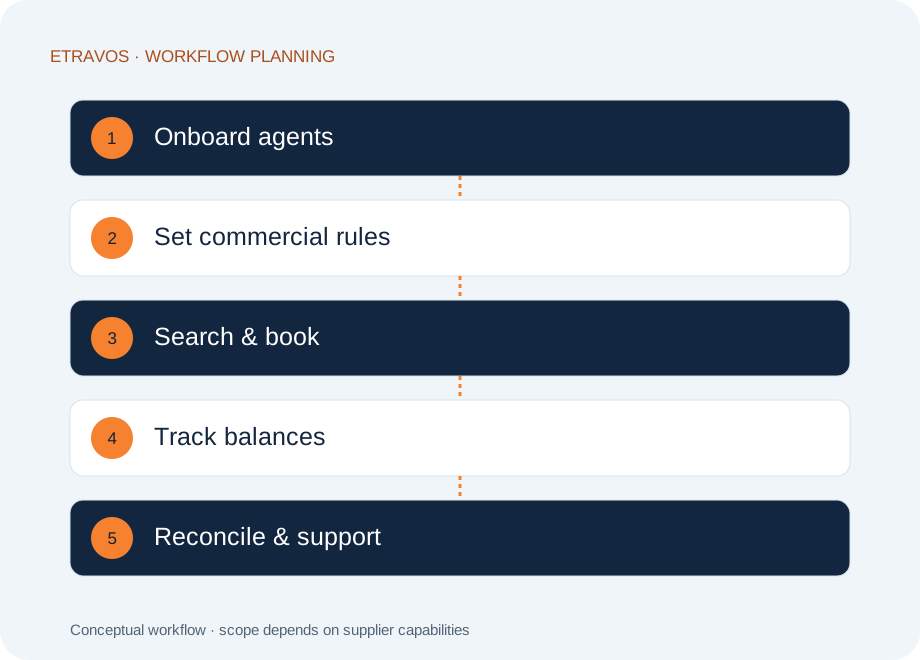
Define administrator, distributor, agent and support roles before building the portal. Decide who can create users, change pricing, view customer information or approve financial adjustments. Give each role the minimum access required for its work.
Document how supplier cost, markup, service fees and commissions produce the final amount. Test whether rules vary by product, agent or account. Staff should be able to explain a price without manually reconstructing it from multiple spreadsheets.
Choose the permitted payment and settlement arrangements for each account. Specify booking limits, balance updates, refunds and adjustments. Credit policies are business decisions that must be approved; software should enforce the agreed rules rather than invent them.
Bring your supplier setup and customer journey. Define the next step with eTravos.
Agents need booking search, documents, cancellation status and a way to request help. Keep the customer booking reference connected to the supplier and financial records so service teams can resolve issues efficiently.
Test the full journey with the roles and products you intend to launch. Include rejected permissions, insufficient balances, duplicate submits and refunds. Introduce new inventory only after the core operating rules have been validated.
Share your current agent network, supplier contracts, products and commercial policies with eTravos. A scope should separate inventory access, portal configuration, custom workflows, training and ongoing support.
B2B serves agents or business accounts and usually needs account-level commercial rules. B2C focuses on direct traveller shopping and checkout.
That requires a defined hierarchy and financial model. Review B2B2B distribution requirements separately rather than assuming a basic agent portal includes them.
An additional distributor or sub-agent layer introduces separate permissions, pricing and settlement responsibilities. Define which organisation owns each booking and who may view, amend or refund it.
Document markups, commissions, credit or wallet arrangements, settlement cycles and responsibility for failed bookings. These rules should be testable examples rather than informal assumptions.
Check visibility of fares and customer data, access to reports, booking permissions and cancellation authority. Test the same transaction under distributor, agent and operations roles to expose permission or reconciliation gaps.
Tell us about your business model, suppliers and current software. We will discuss the relevant workflows and confirm the project scope before proposing delivery or commercial terms.
Talk to eTravos →Explore practical guidance on platforms, integrations and booking operations.
Practical insight for travel businesses building connected digital booking and distribution experiences.
Read article →Practical insight for travel businesses building connected digital booking and distribution experiences.
Read article →