Skip to content
eTravos
TRAVEL TECHNOLOGY · IMPLEMENTATION & BUYER GUIDE

Consolidated Bus Booking API for Multi-Operator Distribution

A consolidated bus booking API provides a common integration layer for inventory from multiple bus operators or distribution sources. It can simplify how a travel platform accesses routes, schedules, seat layouts and booking operations, but the exact coverage and capabilities depend on the provider’s contracts and technical design. The important decision is how the connection handles differences between sources throughout the booking lifecycle.

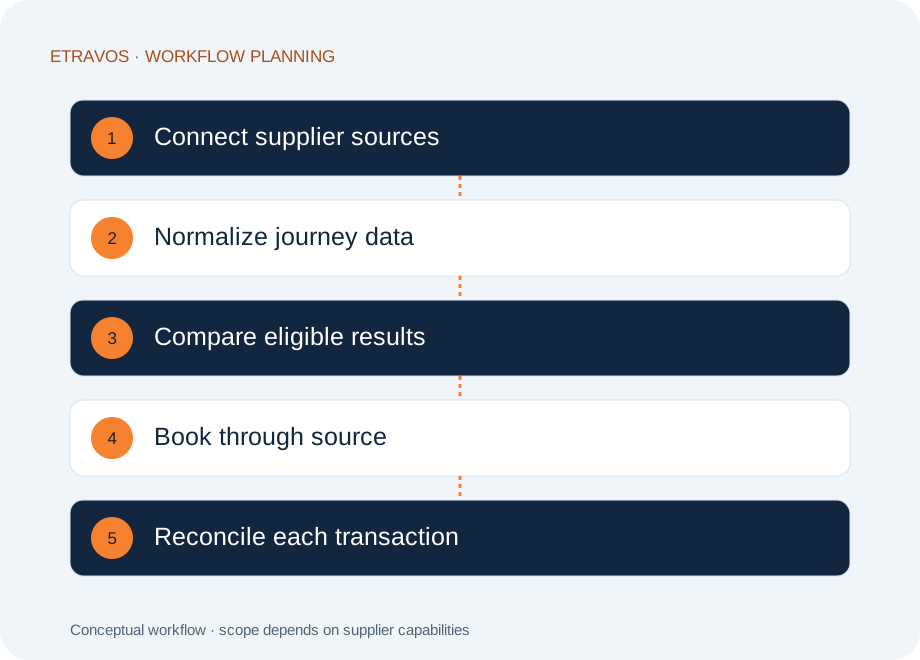
Connect supplier sources → Normalize journey data → Compare eligible results → Book through source → Reconcile each transaction
Conceptual workflow. Supported operations are confirmed during scoping.
01 / Consolidated Bus Booking API

What consolidation changes for a travel business

With separate connections, your application must handle each supplier’s authentication, response format and error behaviour. A consolidated layer can provide a common contract to the consuming application while maintaining source-specific adapters behind it.

That can reduce repeated integration work, but it does not remove supplier-specific rules. Cancellation deadlines, seat restrictions, confirmation timing and available operations may still differ. A useful evaluation makes these differences visible rather than assuming every source behaves the same way.

02 / Consolidated Bus Booking API

Coverage should be demonstrated route by route

An operator count does not tell you whether your priority routes are available on the dates your customers travel. Build a representative route list that includes major corridors, regional journeys, overnight services and peak travel periods.

Compare search results, seat availability, policy information and booking completion for those journeys. Ask which inventory is contracted, which is accessible through intermediaries and what happens when a source is unavailable. Confirm coverage as part of the agreement instead of treating an illustrative website metric as a commitment.

03 / Consolidated Bus Booking API

Normalize information without losing its meaning

Different sources may name boarding points, bus types and operators differently. Normalize fields for display and comparison while keeping the original supplier references for booking and support. Do not merge two services just because their route names look similar.

A duplicate-detection strategy should consider departure time, operator identity, service identifiers and the source’s rules. Fare comparisons should use equivalent passenger conditions and the total payable price. Otherwise, apparently cheaper results may exclude fees or carry different cancellation conditions.

Map the connection to your business.

Bring your supplier setup and customer journey. Define the next step with eTravos.

Request a consultation →
04 / Consolidated Bus Booking API

Choose a source before making a transaction

Search aggregation and transaction routing are different decisions. Once a visitor selects a service, keep the booking associated with the source that supplied its availability and fare. Revalidate using the appropriate source operation.

Do not silently fail over a paid booking to a different supplier. The seat, fare or policy may change. A recovery flow should resolve the original booking state before offering an alternative, with the customer’s consent where the journey changes.

05 / Consolidated Bus Booking API

Keep settlement and support traceable

Store your internal order reference alongside supplier, operator, booking and payment references. Maintain a transaction history so an agent can trace what happened during confirmation, cancellation and refund processing.

Reporting should distinguish customer collections, supplier charges, commercial adjustments and refund liabilities. Reconciliation requirements depend on whether suppliers use a wallet, credit arrangement or another settlement model. Confirm these responsibilities before connecting the inventory to an agent network.

06 / Consolidated Bus Booking API

Direct operator API or consolidated API?

A direct connection may fit when a business has a narrow supplier requirement and wants to manage that relationship closely. A consolidated connection may fit when broader inventory access and a common technical interface are priorities. Neither option is automatically better.

Compare the available operations, data consistency, commercial dependency, support model and ability to change providers. If you already have several contracts, discuss whether to retain them through separate adapters or use a consolidated source for selected markets.

07 / Consolidated Bus Booking API

Define a staged launch and ownership model

Start with representative suppliers and routes. Verify normalization, seat selection, pending bookings, cancellations and reconciliation before adding more sources. Agree which party owns supplier onboarding, operational incidents and changes to API versions.

Bring eTravos your route priorities, distribution channels, current contracts and settlement requirements. Request a scope that separates platform work, supplier access, commercial rules and ongoing operations. This creates a more reliable basis for comparison than a proposal that promises broad coverage without showing the booking and service workflow.

Frequently asked questions

Does consolidated mean every bus operator is available?

No. Availability is determined by the provider’s agreements, technical connections and the routes and dates requested. Ask for a demonstrated coverage assessment.

Can consolidated APIs return duplicate journeys?

They can when inventory overlaps across sources. The integration needs rules for identifying equivalent services while retaining supplier-specific prices and policies.

Can a failed booking be retried through another supplier?

Only after the original transaction state is resolved and any changed fare, seat or terms are handled correctly. Automatic cross-supplier retries can create duplicate or inconsistent bookings.

How is this different from a standard bus booking API?

A bus booking API describes the booking operations. Consolidation describes combining multiple inventory sources behind an interface. A provider may offer both capabilities together.

What should we validate before choosing a bus API?

Compare route coverage, seat-layout accuracy, boarding and dropping points, cancellation rules and booking status behaviour. Test the routes your customers actually buy; an operator count alone does not establish usable coverage.

How should a failed or uncertain bus booking be handled?

Treat payment status and supplier booking status separately. An uncertain response should trigger a status check and an operations review, not an automatic second booking. Agree the refund and customer communication process before launch.

Can multiple bus operators use the same booking journey?

That depends on the supplier interfaces and commercial access available. The integration scope should define how operator-specific seats, fares, policies and ticket references are mapped without hiding differences that matter to the traveller.

Turn the requirements into a practical scope.

Tell us about your business model, suppliers and current software. We will discuss the relevant workflows and confirm the project scope before proposing delivery or commercial terms.

Talk to eTravos →
THE LATEST FROM ETRAVOS

Ideas for your next travel technology decision.

Explore practical guidance on platforms, integrations and booking operations.

View all articles →