Routes, pickup points and journey dates
Agree the required data, permissions and exception handling for this stage before implementation.

Help travellers and agents find suitable bus journeys, rental vehicles and transfers with clear availability and booking steps.
Discuss your requirements →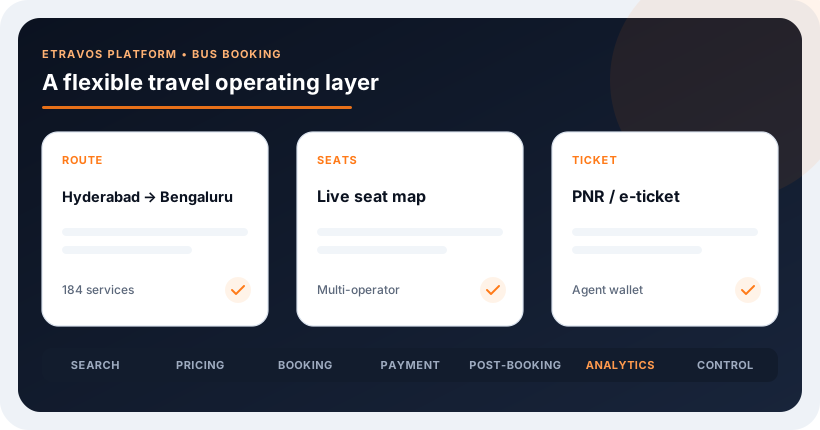
Define the users, inventory sources and commercial rules first. Then connect the customer experience with the work your operations team needs to manage.
Agree the required data, permissions and exception handling for this stage before implementation.
Agree the required data, permissions and exception handling for this stage before implementation.
Agree the required data, permissions and exception handling for this stage before implementation.
Agree the required data, permissions and exception handling for this stage before implementation.
Bus buyers choose routes, boarding points and seats. Car and transfer customers choose pickup details, vehicle capacity and journey requirements. Present these as clear product journeys while keeping the account, payment and support experience consistent where the scope allows.
Help travellers and agents find suitable bus journeys, rental vehicles and transfers with clear availability and booking steps.
Identify supplier accounts, credentials, content ownership and the people responsible for updates.
Test successful transactions, unavailable inventory, price changes, retries and cancellation behaviour against your scope.
Agree reporting, support handoffs and the launch checklist with your operations team.
Test a bus route with multiple boarding points alongside an airport transfer with a delayed arrival. The confirmation should communicate the details each traveller actually needs. Operations should be able to distinguish an unavailable seat from a driver-assignment question.
Bring your operations lead and supplier contact into the scope review. For bus booking, the decisions around routes, boarding points, seat layouts and operator policies need named owners and clear acceptance criteria.
We will review your platform, supplier interfaces and data requirements to define a suitable integration approach.
The booking model, inventory ownership, supplier capabilities, user roles and post-booking requirements shape the scope. Provider agreements and API access must be confirmed.
Compare route coverage, seat-layout accuracy, boarding and dropping points, cancellation rules and booking status behaviour. Test the routes your customers actually buy; an operator count alone does not establish usable coverage.
Treat payment status and supplier booking status separately. An uncertain response should trigger a status check and an operations review, not an automatic second booking. Agree the refund and customer communication process before launch.
That depends on the supplier interfaces and commercial access available. The integration scope should define how operator-specific seats, fares, policies and ticket references are mapped without hiding differences that matter to the traveller.
Share your requirements and the systems you already use.
Talk to an Expert →Use these guides to review the decisions behind your platform scope.
Explore practical guidance on platforms, integrations and booking operations.
Practical insight for travel businesses building connected digital booking and distribution experiences.
Read article →Practical insight for travel businesses building connected digital booking and distribution experiences.
Read article →Practical insight for travel businesses building connected digital booking and distribution experiences.
Read article →