
Travel technology becomes valuable when it removes friction from a real commercial workflow. This article looks at travel technology for hyderabad travel businesses through that lens: what needs to work, why it matters, what teams should validate and where a connected platform can create room for growth.
Start with the operating model, not the feature list
A travel platform is rarely a single screen. A booking request moves through search, availability, pricing, customer or agent rules, supplier confirmation, payment, ticketing or voucher generation and post-booking support. Each transition creates a chance for data to be lost, duplicated or delayed.
For that reason, the strongest technology projects begin by mapping the operating model. Who is searching? Who is paying? Who can change a booking? Who controls the commercial rule? Which supplier is authoritative? What does the finance team need after confirmation? Those questions create a much better foundation than starting with a list of buttons.
The experience layer has to make complexity feel simple
Travel products can expose enormous amounts of information. The design challenge is to help the user make a decision without forcing them to understand the technology underneath. Search results should make meaningful comparisons possible; filters should reduce noise; pricing should explain what is included; and checkout should feel predictable.
For agent-facing products, speed matters differently. Agents may repeat the same workflow dozens of times a day, so shortcuts, persistent preferences, clear status, credit visibility and quick document access can matter more than decorative interactions.
The integration layer should protect the experience
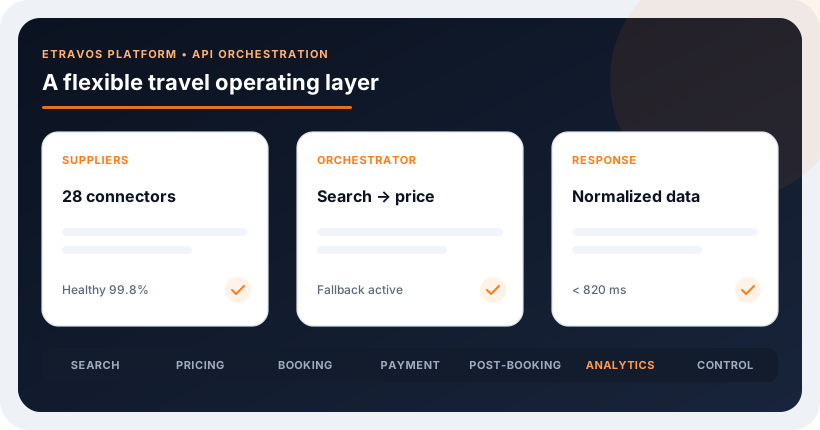
Supplier APIs are not the product. They are inputs to the product. A mature architecture normalizes supplier responses, separates supplier-specific logic from business rules, monitors failures and gives the platform a stable internal model. That makes it easier to add another supplier later without redesigning the customer experience.
For flight, hotel and bus content, teams should think about mapping, availability changes, pricing differences, cancellation rules, booking confirmation and error recovery. A beautiful front end cannot compensate for a fragile transaction layer.
Commercial flexibility is part of the product
In B2B travel, the same inventory can be sold differently to different customers. Markups, commissions, credit limits, customer groups, branch rules and distribution agreements can shape the actual business outcome. In corporate travel, policies and approvals create another layer of logic. In B2C, conversion, trust and payment experience become central.
That means commercial rules should be designed as first-class platform capabilities, not hidden inside one-off custom code. The result is easier to operate and easier to change.
What to validate before you choose a platform
- Can the platform support the business model you operate today?
- Can you add suppliers or products without rebuilding the entire journey?
- Are roles, permissions and commercial rules understandable?
- How are booking failures, cancellations and amendments handled?
- Can the management team see what is happening across the business?
- What is the operating model after launch for enhancements and supplier changes?
Where eTravos fits
eTravos is positioned around the connected layer between travel supply and the businesses that sell it. Depending on the requirement, that can include travel portals, B2B distribution, corporate booking, flight, hotel and bus APIs, booking engines, mobile experiences, marketplaces and operational workflows.
The practical question is not whether every business needs every module. It is which capabilities should be connected first, and which can be introduced as the business grows.
Takeaway
The best travel technology decisions create optionality. They let a business change its customer experience, supplier mix, commercial model or distribution strategy without throwing away the platform underneath. That is the standard worth using when evaluating the next technology investment.
Continue deeper into the platform with Travel Portal Development, Travel API Integration Services and Travel Booking Engine Development.