
Scaling Sub-Second Flight Search & PNR Ticketing for a Pan-India Enterprise TMC
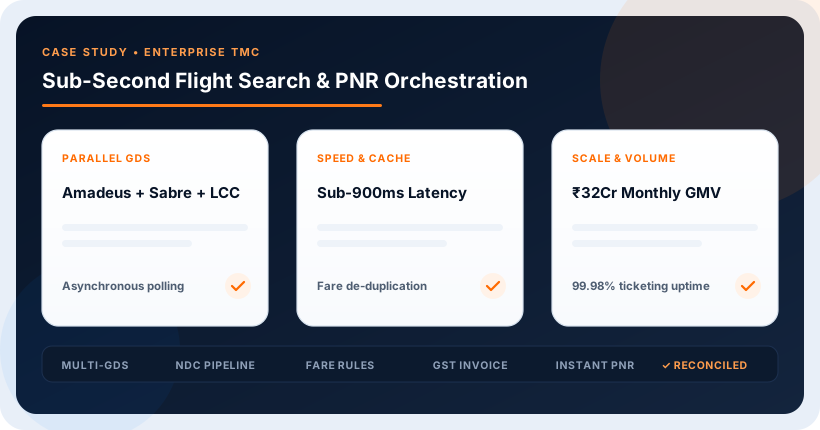
How a tier-1 Indian travel management company conquered 7-second GDS latency, eliminated fare expiration drops, and scaled flight booking GMV to ₹32Cr/month using eTravos Unified Flight Engine.
Executive Overview
How a tier-1 Indian travel management company conquered 7-second GDS latency, eliminated fare expiration drops, and scaled flight booking GMV to ₹32Cr/month using eTravos Unified Flight Engine.
The Business Challenge
The client operated an enterprise corporate travel desk servicing over 2,500 corporate entities across India. During peak business booking hours (9:30 AM to 12:30 PM), concurrent flight search queries overwhelmed their legacy on-premise system. Sequential polling of Amadeus, Sabre, and direct LCC airline APIs pushed average search response times past 7.2 seconds. Crucially, 8.6% of customer booking attempts failed at checkout because fares had expired on airline CRS systems between search and payment. Reconciling airline BSP billing files with internal corporate ledgers required four full-time finance associates working over 4 days each cycle.
The eTravos Solution
eTravos deployed its cloud-native Unified Flight Engine with asynchronous multi-GDS parallel polling. The system simultaneously dispatches search requests across Amadeus GDS, Sabre NDC, IndiGo Direct Connect, Air India Express, Akasa Air, and SpiceJet. An in-memory distributed cache layer deduplicates duplicate flights, standardizes cabin classes, and calculates dynamic markup rules in under 120 milliseconds. Automated PNR ticketing queues lock seat allocations immediately upon corporate credit approval, while direct integration with corporate GST engines generates 100% compliant tax invoices automatically.
Technical Architecture & Data Flow
To eliminate operational lag and guarantee transaction consistency, the following core processing pipeline was implemented:
- Asynchronous Parallel Polling: Queries are fanned out simultaneously to 12 distinct GDS, NDC and LCC airline endpoints with a strict 900ms timeout threshold.
- Intelligent De-duplication & Fare Rules: The eTravos normalization layer eliminates identical multi-source flight numbers and compares baggage allowance, cancellation penalties, and seat selection fees into a unified response schema.
- Instant PNR & Seat Allotment Queue: Upon policy approval, the automated booking daemon issues PNRs via direct API pipes without human intervention, preventing seat loss.
- ERP & GST Accounting Sync: Every ticket issuance triggers an instant automated ledger entry, calculating airline commissions and emailing compliant B2B tax invoices directly to the corporate client.
Measurable Business Outcomes
The transition to eTravos delivered verified operational gains within the first 90 days of production deployment:
Implementation Lessons & Best Practices
Sequential supplier API querying is fatal for high-volume travel businesses. By transitioning to eTravos asynchronous parallel orchestration with real-time in-memory caching, enterprise TMCs can deliver sub-second consumer-grade search speeds while eliminating the financial leakages of fare expirations and manual reconciliation.
Explore this architecture for your travel operations
Schedule a private architectural review with an eTravos platform specialist to evaluate your distribution workflows and supplier integrations.
Request an Architectural Consultation →